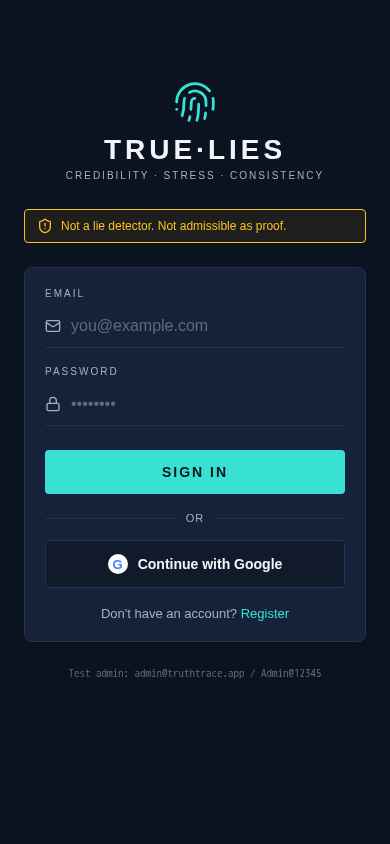
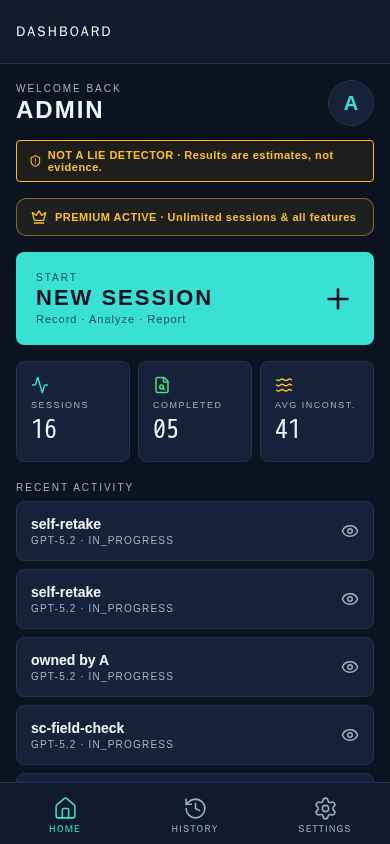
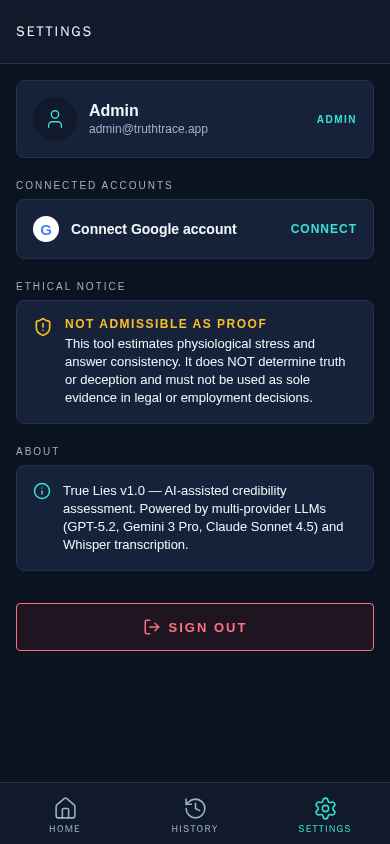
True Lies listens to what's actually said, scores vocal stress and consistency in real time, and hands you a report — not a verdict. The tough conversation still happens. Now it happens with receipts.
TOPIC: Relationship honesty & trust
Q1 — "Where were you last night?"
True Lies is a voice‑analysis app for conversations you're already going to have anyway — with a partner, a roommate, a teenager who swears they didn't touch the car. You ask the questions out loud. It listens, transcribes, and scores what it hears.
Each answer is transcribed and scored for vocal stress markers and consistency — hesitation, tone shifts, and contradictions against earlier answers in the same session. That's it. It's a read on how something was said and whether the story holds together, not a verdict on whether it's true.
No. Real polygraphs measure physiological signals like heart rate, breathing, and skin conductance through sensors attached to the body. True Lies works from voice alone through a phone microphone, which is a much narrower — and much less certain — signal. Courts and employers don't accept polygraph results as proof either; this app makes no attempt to clear that bar.
Not yet. Voice analysis, the AI interview engine, and the credibility report are live today. Camera-based heart-rate and facial-tension tracking is on the roadmap — see The Credibility Engine for what's shipping next and how we're handling it responsibly.
People who want structure for a conversation that's about to get emotional anyway — set a topic, load a few questions, and let the session hold both people to what they actually said. It's built for personal use between people who both know the session is happening, not covert surveillance.
Audio is transcribed and analyzed by the app's AI providers to generate your session report, then stored in your account history so you can revisit it later. See the Privacy Policy for exactly what's collected and how long it's kept.
Pick a topic, ask your questions — written yourself or AI‑generated — and let the session run. Every answer gets full voice and stress analysis, start to finish.
Choose a subject — relationship honesty, a job interview, a family dispute — and load starter questions or write your own.
Whisper transcription plus a rotation of GPT‑5.2, Gemini 3 Pro, and Claude Sonnet 4.5 score tone, hesitation, and inconsistency as the session plays out.
Every session lands in your history with a credibility score, a stress timeline, and the flagged answers worth a follow‑up question.
Four systems work together during a session. Two are live in the app today; two are on the roadmap. Every one of them produces a signal to review — never a ruling.
Runs on every session from a phone microphone — no extra hardware.
It flags answers as "needs review" — never as "lying."
rPPG is a real, published technique — and a genuinely sensitive one. It degrades quickly under poor lighting or movement, so we show a live quality check rather than a confident number when conditions are bad.
Every report ships with the same line at the bottom: not admissible as proof.
Polygraphs measure physiological arousal — heart rate, breathing, skin conductance — not deception itself; the American Psychological Association is explicit that arousal is not the same signal as a lie, and that no pattern of physiological response has been shown to be unique to dishonesty.
The National Academies of Sciences reached a similar conclusion after reviewing the polygraph research base: accuracy claims are weaker than commonly believed, and the tool is especially unreliable when used to screen large numbers of truthful people rather than to investigate a specific, known event.
A phone microphone and camera pick up a narrower, noisier version of the same kind of signal a polygraph reads from sensors on the body. True Lies is built on that honestly: it reports stress and inconsistency as leads worth a follow-up question, not conclusions about truth.
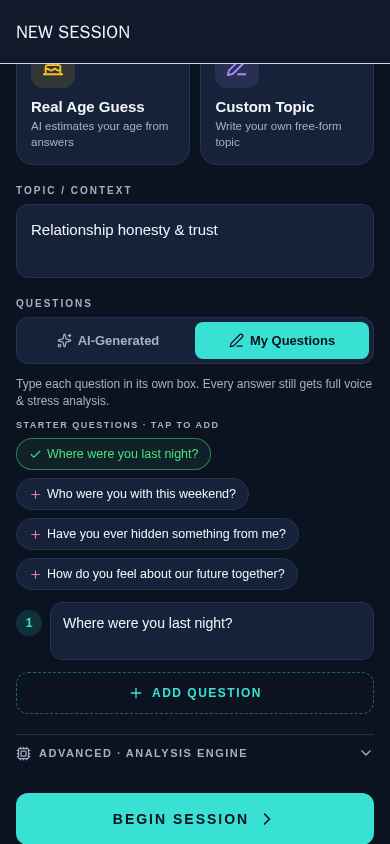
Four screens, one investigation: set up a session, sign in, review the dashboard, and manage the account behind it.
A running gag about a couple who take "honesty" a little too literally. Four clips, one briefcase, zero admissible evidence.
Free to try. Premium unlocks unlimited sessions and the full analysis engine. Available on iOS and Android.
Premium is an auto‑renewing subscription billed through the App Store or Google Play. By subscribing you agree to our Terms & Conditions and Privacy Policy.